
Secrets of an Ancient Computer
(单词翻译:单击)
A mysterious mechanism2 found in a 2,000-year-old Greek shipwreck3 may have been used to calculate the positions of planets, predict when eclipses were to occur, and do other astronomical4 chores.
|
This illustration shows what the machinery inside an ancient astronomical computer might have looked like. The mechanism included sets of gears and moving hands to track astronomical cycles. |
|
Copyright of the Antikythera Mechanism Research Project |
Known as the Antikythera (pronounced an-tee-KITH-air-uh) mechanism, the device is about the size of a shoebox. When it was found underwater about 100 years ago, the mechanism was in poor shape. Its metal pieces had congealed6 into one mass, then broken into pieces.
People who studied what was left of the mechanism suspected that it had something to do with astronomy. To find out more, researchers recently used advanced imaging methods, including X-ray computer tomography, to look inside the metal fragments and to check for ancient writing on the device.
"The computer tomography images of the mechanism have literally7 opened the device up to us to see how it worked," says John M. Steele, who studies ancient astronomy at the University of Durham in England.
The researchers discovered that the mechanism had at least 30 bronze gears with as many as 225 teeth, likely all cut by hand.
This fresh look provided clear evidence that the device could have been used to compute1 eclipses of the sun and moon. A lunar eclipse occurs when the moon passes into Earth's shadow, and a solar eclipse occurs when the moon passes between the sun and Earth.
Scientists suspect that the mechanism was also able to show the motions of the planets. A user could pick a day in the future and, using some sort of crank, work out a planet's position on that date.
The new images doubled the number of engravings that the scientists could read. These inscriptions8 revealed uses for the machine that were previously9 unknown.
With the added information, the researchers came up with a new model for how the mechanism operated. The model takes into account 29 of the 30 known gears and adds five more that were probably there but never found.
 |
|
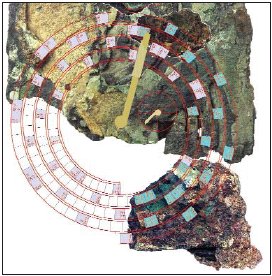
A diagram of a spiral dial for predicting solar and lunar eclipses is superimposed on a photo showing pieces of the metal mechanism brought up from a 2000-year-old shipwreck. |
|
Copyright of the Antikythera Mechanism Research Project |
The new picture adds a previously undiscovered spiral dial to the back of the device near the bottom. A hand moving around the dial could have pointed10 to eclipses over a period of 18 years.
All these findings show that the Antikythera mechanism was perhaps 1,000 years ahead of anything else discovered from its time period.—E. Sohn
 收听单词发音
 |
1
compute
|
|
| v./n.计算,估计 | |
参考例句: |
|
|
|
|
2
mechanism
|
|
| n.机械装置;机构,结构 | |
参考例句: |
|
|
|
|
3
shipwreck
|
|
| n.船舶失事,海难 | |
参考例句: |
|
|
|
|
4
astronomical
|
|
| adj.天文学的,(数字)极大的 | |
参考例句: |
|
|
|
|
5
machinery
|
|
| n.(总称)机械,机器;机构 | |
参考例句: |
|
|
|
|
6
congealed
|
|
| v.使凝结,冻结( congeal的过去式和过去分词 );(指血)凝结 | |
参考例句: |
|
|
|
|
7
literally
|
|
| adv.照字面意义,逐字地;确实 | |
参考例句: |
|
|
|
|
8
inscriptions
|
|
| (作者)题词( inscription的名词复数 ); 献词; 碑文; 证劵持有人的登记 | |
参考例句: |
|
|
|
|
9
previously
|
|
| adv.以前,先前(地) | |
参考例句: |
|
|
|
|
10
pointed
|
|
| adj.尖的,直截了当的 | |
参考例句: |
|
|
|


