
To Catch a Dragonfly
(单词翻译:单击)
"They're so quick and so smart, it sometimes takes us hours with five people to catch one," says Martin Wikelski. He's an ecologist at Princeton University in New Jersey1.
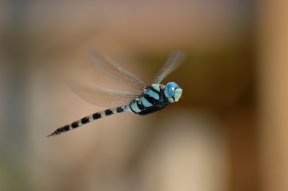 |
|
A dragonfly in flight. |
|
iStockphoto.com |
The pencil-thin, four-winged insects hover2 and dart3, changing directions in an instant.
"They're amazing," Wikelski says. "They're like little helicopters."
Despite the challenges, scientists chase dragonflies to better understand their behavior, their habitats, and the dangers that threaten them. Surprises keep popping up, and dragonflies are giving researchers new ways to think about interactions in nature.
Long-distance flyer
Dragonflies date back at least 250 million years, says Daniel Soluk, an ecologist at the University of South Dakota in Vermillion. Alongside dinosaurs4, they flitted across the prehistoric5 landscape on 2-foot-wide wingspans.
Although dragonflies have been around for a long time and live in many parts of the world, scientists still know remarkably6 little about them.
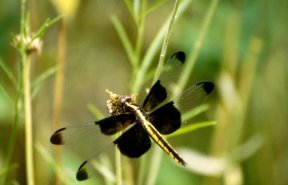 |
|
There are about 5,700 types of dragonflies around the world. |
|
Photo by LaVonda Walton, U.S. Fish and Wildlife Service |
You've probably seen dragonflies. The insects are welcome picnic guests because they eat mosquitoes. What you might not know is that some of these mosquito hunters are long-distance flyers.
Out of about 5,700 known species of dragonflies, as many as 50 species fly to warmer places for the winter, just like migrating birds do. Unlike birds, however, dragonflies appear to migrate in only one direction. Mom and dad may migrate south for the winter, but it's the next generation that probably makes the return trip.
Radio alert
To confirm that certain dragonflies migrate, Wikelski and his coworkers used eyelash adhesive7 to attach tiny radio transmitters to individual insects. Even though the devices were very small, they still weighed about one-third as much as an adult dragonfly.
Luckily, dragonflies can carry heavy loads. "They seemed totally fine with it," Wikelski says.
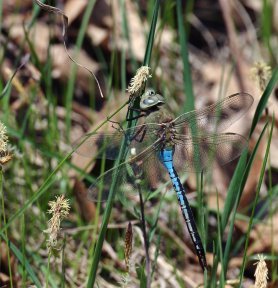 |
|
By attaching tiny radio transmitters to green darner dragonflies, researchers discovered that these insects can travel many kilometers in 1 day. |
|
Photo © Phil Myers, Museum of Zoology8, University of Michigan Animal Diversity Web site (animaldiversity.org). |
In their experiment, Wikelski and his team used an airplane to track 14 dragonflies carrying transmitters. Twelve days of observations confirmed that the dragonflies did migrate.
When temperatures dropped two nights in a row, the researchers found, the dragonflies took off southward. In less than 2 weeks, some of the insects covered about 60 kilometers (37 miles).
Some dragonflies go even farther, Soluk says. They've been known to show up on ships hundreds of miles out at sea.
Mysterious flights
Strangely, no one has ever observed dragonflies flying north in the springtime, even though it must happen.
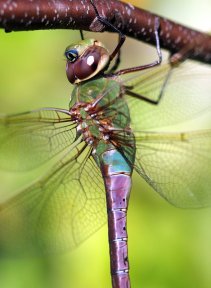 |
|
A female green darner dragonfly. |
|
Photo by Michelle L. St. Sauveur, On Nature's Wing Wildlife and Nature Photography (www.onnatureswing.com). |
"Sometimes, dragonflies show up in New Jersey when ponds are still frozen," Wikelski says. The insects had to have come from somewhere else because dragonfly eggs need liquid water to hatch.
"This is the kind of stuff that kids can observe," he notes. By making such observations, students can help researchers understand where dragonflies come from and where they go.
Of the many remaining questions about dragonfly migration9, Wikelski is particularly interested in finding out how much energy their journeys require. Evidence suggests that they simply ride the wind, so migration might be easy. He hopes someday to track dragonflies using satellites in space.
Puzzling patterns
Because of disappearing wetlands, the use of pesticides10, and changes in groundwater flow, some dragonfly species are threatened with extinction11. But scientists are discovering quirks12 in the behavior of these insects that might help keep them from dying out.
When Soluk started studying an endangered species called the Hine's emerald dragonfly, for example, he was puzzled: Sometimes these dragonflies were easy to find, but at other times they were impossible to locate.
|
Hine's emerald dragonfly has bright, emerald-green eyes and a metallic body, with yellow stripes on its sides. Its body is about 2.5 inches long and its wingspan reaches 3.3 inches. It is an endangered species and can be found today only in Illinois, Michigan, Missouri, and Wisconsin. |
|
U.S. Fish & Wildlife Service |
For instance, when streams flowed in the spring, sampling turned up lots of Hine's emeralds. As the water dried up, the dragonflies disappeared. Then, next spring, their population boomed again.
This species doesn't migrate, so they were obviously hiding somewhere. But where?
"We spent a lot of time looking in places where we thought they might over-winter," Soluk says.
After repeated failures, the researchers checked the last hiding spot available: crayfish burrows15. Crayfish eat Hine's emeralds, so it seemed an unlikely place for them to be.
"In the first burrow14, we found two [dragonflies]," Soluk says. "In the second, we found 24. There were as many as 74 in one burrow."
Saving endangered species
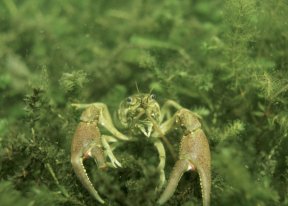
These findings suggest that saving an endangered species can be complicated. It would be easy, for example, to assume that getting rid of predators16 would help dragonflies, Soluk says. But in fact, Hine's emeralds depend on crayfish burrows for their survival.
 |
|
Crayfish eat dragonflies, but some dragonflies depend on crayfish burrows for shelter during the winter. |
|
Photo by Eric Engbretson, U.S. Fish & Wildlife Service |
It's still not clear why crayfish don't eat the dragonflies hiding in their burrows. It's possible, for example, that the insects use camouflage17 or chemical odors to make themselves unappetizing.
Scientists are finding similar interactions among other creatures, including alligators18 and fish in Florida.
"Ecosystems19 are very complicated networks of interaction," Soluk says. "We need to know all of the links before we start messing with them."
The best way to protect dragonflies, Soluk says, is not to destroy their predators but to protect their habitats. With ever-expanding development and pollution, wetlands are disappearing, and dragonflies are losing sources of fresh groundwater.
By saving wetlands, we can save more than the Hine's emerald. "They're an indicator20 for a whole lot of other species that are vanishing," Soluk says.
So, if you manage to catch a dragonfly, be gentle. Take a close look. Then, let it go. It has important work to do.
 收听单词发音
 |
1
jersey
|
|
| n.运动衫 | |
参考例句: |
|
|
|
|
2
hover
|
|
| vi.翱翔,盘旋;徘徊;彷徨,犹豫 | |
参考例句: |
|
|
|
|
3
dart
|
|
| v.猛冲,投掷;n.飞镖,猛冲 | |
参考例句: |
|
|
|
|
4
dinosaurs
|
|
| n.恐龙( dinosaur的名词复数 );守旧落伍的人,过时落后的东西 | |
参考例句: |
|
|
|
|
5
prehistoric
|
|
| adj.(有记载的)历史以前的,史前的,古老的 | |
参考例句: |
|
|
|
|
6
remarkably
|
|
| ad.不同寻常地,相当地 | |
参考例句: |
|
|
|
|
7
adhesive
|
|
| n.粘合剂;adj.可粘着的,粘性的 | |
参考例句: |
|
|
|
|
8
zoology
|
|
| n.动物学,生态 | |
参考例句: |
|
|
|
|
9
migration
|
|
| n.迁移,移居,(鸟类等的)迁徙 | |
参考例句: |
|
|
|
|
10
pesticides
|
|
| n.杀虫剂( pesticide的名词复数 );除害药物 | |
参考例句: |
|
|
|
|
11
extinction
|
|
| n.熄灭,消亡,消灭,灭绝,绝种 | |
参考例句: |
|
|
|
|
12
quirks
|
|
| n.奇事,巧合( quirk的名词复数 );怪癖 | |
参考例句: |
|
|
|
|
13
metallic
|
|
| adj.金属的;金属制的;含金属的;产金属的;像金属的 | |
参考例句: |
|
|
|
|
14
burrow
|
|
| vt.挖掘(洞穴);钻进;vi.挖洞;翻寻;n.地洞 | |
参考例句: |
|
|
|
|
15
burrows
|
|
| n.地洞( burrow的名词复数 )v.挖掘(洞穴),挖洞( burrow的第三人称单数 );翻寻 | |
参考例句: |
|
|
|
|
16
predators
|
|
| n.食肉动物( predator的名词复数 );奴役他人者(尤指在财务或性关系方面) | |
参考例句: |
|
|
|
|
17
camouflage
|
|
| n./v.掩饰,伪装 | |
参考例句: |
|
|
|
|
18
alligators
|
|
| n.短吻鳄( alligator的名词复数 ) | |
参考例句: |
|
|
|
|
19
ecosystems
|
|
| n.生态系统( ecosystem的名词复数 ) | |
参考例句: |
|
|
|
|
20
indicator
|
|
| n.指标;指示物,指示者;指示器 | |
参考例句: |
|
|
|
- 上一篇:计算机与因特网插件指南
- 下一篇:Back to the Moon


