
古遗址显示同类相食的迹象
(单词翻译:单击)
Archaeologists have found evidence of mass cannibalism1 at a 7,000-year-old human burial site in south-west Germany, the journal Antiquity2 reports.
杂志《古代》报道,考古学家在德国西南部一处7000年的人类埋葬地发现大量同类相食的证据。
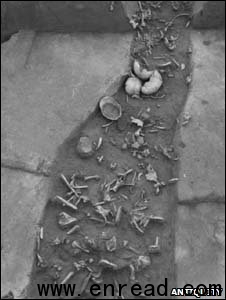 remains3 of 500 "intentionally4 mutilated" humans" width="226" height="300" src="http://www.enread.com/upimg/091207/4_060004_1.jpg" />
The site contains remains of 500 "intentionally mutilated" humans
The authors say their findings provide rare evidence of cannibalism同类相食,吞食 in Europe's early Neolithic5 period新石器时代.
Up to 500 human remains unearthed6出土 near the village of Herxheim may have been cannibalised.
The "intentionally mutilated切断,使残废" remains included children and even unborn babies, the researchers say.
The German site was first excavated挖开,凿通 in 1996 and then explored again between 2005 and 2008.
Team leader Bruno Boulestin, from the University of Bordeaux in France, told BBC News that he and his colleagues had found evidence the human bones were deliberately8故意地 cut and broken - an indication of cannibalism.
"We see patterns on the bones of animals indicating that they have been spit-roasted," he said. "We have seen some of these same patterns on the human bones [at this site]."
But Dr Boulestin stressed it was difficult to prove that these bones had been deliberately cooked.
Some scientists have rejected the cannibalism theory, suggesting that the removal of flesh could have been part of a burial埋葬 ritual仪式.
But Dr Boulestin said the human remains had been "intentionally mutilated" and that there was evidence many of them had been chewed咀嚼.
The early Neolithic was the period when farming first spread in central Europe and the team believes that cannibalism in Europe was likely to have been exceptional - possibly carried out during periods of famine饥荒.
 收听单词发音
 |
1
cannibalism
|
|
| n.同类相食;吃人肉 | |
参考例句: |
|
|
|
|
2
antiquity
|
|
| n.古老;高龄;古物,古迹 | |
参考例句: |
|
|
|
|
3
remains
|
|
| n.剩余物,残留物;遗体,遗迹 | |
参考例句: |
|
|
|
|
4
intentionally
|
|
| ad.故意地,有意地 | |
参考例句: |
|
|
|
|
5
neolithic
|
|
| adj.新石器时代的 | |
参考例句: |
|
|
|
|
6
unearthed
|
|
| 出土的(考古) | |
参考例句: |
|
|
|
|
7
excavated
|
|
| v.挖掘( excavate的过去式和过去分词 );开凿;挖出;发掘 | |
参考例句: |
|
|
|
|
8
deliberately
|
|
| adv.审慎地;蓄意地;故意地 | |
参考例句: |
|
|
|
- 上一篇:哥本哈根气候变化峰会即将开幕
- 下一篇:英国洞穴蜘蛛被“送回家”


