
“末日时钟”提前一分钟
(单词翻译:单击)
The Doomsday Clock - a barometer1 of nuclear danger for the past 55 years - has been moved one minute further away from the "midnight hour".
“末日时钟”——过去55年核危险的晴雨表——被从“午夜时分”再向前提前了一分钟。
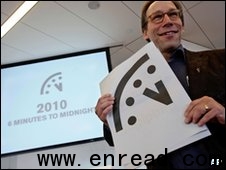
The Doomsday Clock has shifted to six minutes before midnight
The concept timepiece计时器, devised by the Bulletin公告,公报 of the Atomic Scientists (BAS) now stands at six minutes to the hour.
The group said it made the decision to move the clock back because of a more "hopeful state of world affairs".
The clock was first featured by the magazine in 1947, shortly after the US dropped its A-bombs on Japan.
The clock had been adjusted 18 times before today since its initial start at seven minutes to midnight.
Most recently, in January 2007, the clock moved to five minutes to midnight, when climate change was added to the prospect2 of nuclear annihilation消灭,灭绝 as the greatest threats to humankind.
The concerns then included Iran's nuclear ambitions野心,抱负 and the inability to halt the international trafficking of nuclear materials such as highly enriched uranium and plutonium钚.
See how the clock has changed
Two years later, however, the board of the BAS says that there is now a "growing political will" to tackle both the "terror of nuclear weapons" and "runaway3 climate change".
At a news conference in New York, the BAS board said: "By shifting the hand back from midnight by only one additional minute, we emphasize how much needs to be accomplished4, while at the same time recognizing signs of collaboration5 among the United States, Russia, the European Union, India, China, Brazil, and others on nuclear security and on climate stabilization6."
But Lawrence Krauss, co-chair of the BAS board of sponsors, warned scientists that there was still much to be done.
"We urge leaders to fulfill7 the promise of a nuclear weapon-free world and to act now to slow the pace of climate change," he said.
"We are mindful of注意,留心 the fact that the clock is ticking," he added.
The Bulletin of the Atomic Scientists, founded by former Manhattan Project physicists8, has campaigned for nuclear disarmament since 1947.
Its board periodically reviews issues of global security and challenges to humanity, not solely9 those posed by nuclear technology, although most have had a technological10 component11.
 收听单词发音
 |
1
barometer
|
|
| n.气压表,睛雨表,反应指标 | |
参考例句: |
|
|
|
|
2
prospect
|
|
| n.前景,前途;景色,视野 | |
参考例句: |
|
|
|
|
3
runaway
|
|
| n.逃走的人,逃亡,亡命者;adj.逃亡的,逃走的 | |
参考例句: |
|
|
|
|
4
accomplished
|
|
| adj.有才艺的;有造诣的;达到了的 | |
参考例句: |
|
|
|
|
5
collaboration
|
|
| n.合作,协作;勾结 | |
参考例句: |
|
|
|
|
6
Stabilization
|
|
| 稳定化 | |
参考例句: |
|
|
|
|
7
fulfill
|
|
| vt.履行,实现,完成;满足,使满意 | |
参考例句: |
|
|
|
|
8
physicists
|
|
| 物理学家( physicist的名词复数 ) | |
参考例句: |
|
|
|
|
9
solely
|
|
| adv.仅仅,唯一地 | |
参考例句: |
|
|
|
|
10
technological
|
|
| adj.技术的;工艺的 | |
参考例句: |
|
|
|
|
11
component
|
|
| n.组成部分,成分,元件;adj.组成的,合成的 | |
参考例句: |
|
|
|
- 上一篇:英王子兄弟肖像画曝光 尽显手足之情
- 下一篇:学校必须采用先进的科学技术


