
The Hypocrisy of American Slavery
(单词翻译:单击)
Frederick Douglass (1817-1895) was the best known and most influential1 African American leader of the 1800s. He was born a slave in Maryland but managed to escape to the North in 1838.
He traveled to Massachusetts and settled in New Bedford, working as a laborer2 to support himself. In 1841, he attended a convention of the Massachusetts Antislavery Society and quickly came to the attention of its members, eventually becoming a leading figure in the New England antislavery movement.
In 1845, Douglass published his autobiography3, "The Narrative4 of the Life of Frederick Douglass: an American Slave." With the revelation that he was an escaped slave, Douglass became fearful of possible re-enslavement and fled to Great Britain and stayed there for two years, giving lectures in support of the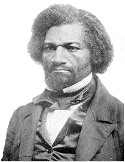 antislavery movement in America. With the assistance of English Quakers, Douglass raised enough money to buy his own his freedom and in 1847 he returned to America as a free man.
He settled in Rochester, New York, where he published The North Star, an abolitionist newspaper. He directed the local underground railroad which smuggled5 escaped slaves into Canada and also worked to end racial segregation6 in Rochester's public schools.
In 1852, the leading citizens of Rochester asked Douglass to give a speech as part of their Fourth of July celebrations. Douglass accepted their invitation.
In his speech, however, Douglass delivered a scathing7 attack on the hypocrisy8 of a nation celebrating freedom and independence with speeches, parades and platitudes9, while, within its borders, nearly four million humans were being kept as slaves.

Fellow citizens, pardon me, and allow me to ask, why am I called upon to speak here today? What have I or those I represent to do with your national independence? Are the great principles of political freedom and of natural justice, embodied10 in that Declaration of Independence, extended to us? And am I, therefore, called upon to bring our humble11 offering to the national altar, and to confess the benefits, and express devout12 gratitude13 for the blessings14 resulting from your independence to us?
Would to God, both for your sakes and ours, that an affirmative answer could be truthfully returned to these questions. Then would my task be light, and my burden easy and delightful15. For who is there so cold that a nation's sympathy could not warm him? Who so obdurate16 and dead to the claims of gratitude, that would not thankfully acknowledge such priceless benefits? Who so stolid17 and selfish that would not give his voice to swell18 the hallelujahs of a nation's jubilee19, when the chains of servitude had been torn from his limbs? I am not that man. In a case like that, the dumb might eloquently20 speak, and the "lame21 man leap as an hart."
But such is not the state of the case. I say it with a sad sense of disparity between us. I am not included within the pale of this glorious anniversary! Your high independence only reveals the immeasurable distance between us. The blessings in which you this day rejoice are not enjoyed in common. The rich inheritance of justice, liberty, prosperity, and independence bequeathed by your fathers is shared by you, not by me. The sunlight that brought life and healing to you has brought stripes and death to me. This Fourth of July is yours, not mine. You may rejoice, I must mourn. To drag a man in fetters22 into the grand illuminated23 temple of liberty, and call upon him to join you in joyous24 anthems25, were inhuman26 mockery and sacrilegious irony27. Do you mean, citizens, to mock me, by asking me to speak today? If so, there is a parallel to your conduct. And let me warn you, that it is dangerous to copy the example of a nation (Babylon) whose crimes, towering up to heaven, were thrown down by the breath of the Almighty28, burying that nation in irrecoverable ruin.
Fellow citizens, above your national, tumultuous joy, I hear the mournful wail29 of millions, whose chains, heavy and grievous yesterday, are today rendered more intolerable by the jubilant shouts that reach them. If I do forget, if I do not remember those bleeding children of sorrow this day, "may my right hand forget her cunning, and may my tongue cleave30 to the roof of my mouth!"
To forget them, to pass lightly over their wrongs and to chime in with the popular theme would be treason most scandalous and shocking, and would make me a reproach before God and the world.
My subject, then, fellow citizens, is "American Slavery." I shall see this day and its popular characteristics from the slave's point of view. Standing31 here, identified with the American bondman, making his wrongs mine, I do not hesitate to declare, with all my soul, that the character and conduct of this nation never looked blacker to me than on this Fourth of July.
Whether we turn to the declarations of the past, or to the professions of the present, the conduct of the nation seems equally hideous32 and revolting. America is false to the past, false to the present, and solemnly binds33 herself to be false to the future. Standing with God and the crushed and bleeding slave on this occasion, I will, in the name of humanity, which is outraged34, in the name of liberty, which is fettered35, in the name of the Constitution and the Bible, which are disregarded and trampled36 upon, dare to call in question and to denounce, with all the emphasis I can command, everything that serves to perpetuate37 slavery -- the great sin and shame of America! "I will not equivocate39 - I will not excuse." I will use the severest language I can command, and yet not one word shall escape me that any man, whose judgment40 is not blinded by prejudice, or who is not at heart a slave-holder, shall not confess to be right and just.
But I fancy I hear some of my audience say it is just in this circumstance that you and your brother Abolitionists fail to make a favorable impression on the public mind. Would you argue more and denounce less, would you persuade more and rebuke41 less, your cause would be much more likely to succeed. But, I submit, where all is plain there is nothing to be argued. What point in the anti-slavery creed42 would you have me argue? On what branch of the subject do the people of this country need light? Must I undertake to prove that the slave is a man? That point is conceded already. Nobody doubts it. The slave-holders themselves acknowledge it in the enactment43 of laws for their government. They acknowledge it when they punish disobedience on the part of the slave. There are seventy-two crimes in the State of Virginia, which, if committed by a black man (no matter how ignorant he be), subject him to the punishment of death; while only two of these same crimes will subject a white man to like punishment.
What is this but the acknowledgment that the slave is a moral, intellectual, and responsible being? The manhood of the slave is conceded. It is admitted in the fact that Southern statute45 books are covered with enactments46, forbidding, under severe fines and penalties, the teaching of the slave to read and write. When you can point to any such laws in reference to the beasts of the field, then I may consent to argue the manhood of the slave. When the dogs in your streets, when the fowls47 of the air, when the cattle on your hills, when the fish of the sea, and the reptiles48 that crawl, shall be unable to distinguish the slave from a brute49, then I will argue with you that the slave is a man!
For the present it is enough to affirm the equal manhood of the Negro race. Is it not astonishing that, while we are plowing50, planting, and reaping, using all kinds of mechanical tools, erecting51 houses, constructing bridges, building ships, working in metals of brass52, iron, copper53, silver, and gold; that while we are reading, writing, and ciphering, acting54 as clerks, merchants, and secretaries, having among us lawyers, doctors, ministers, poets, authors, editors, orators55, and teachers; that we are engaged in all the enterprises common to other men -- digging gold in California, capturing the whale in the Pacific, feeding sheep and cattle on the hillside, living, moving, acting, thinking, planning, living in families as husbands, wives, and children, and above all, confessing and worshipping the Christian56 God, and looking hopefully for life and immortality57 beyond the grave -- we are called upon to prove that we are men?
Would you have me argue that man is entitled to liberty? That he is the rightful owner of his own body? You have already declared it. Must I argue the wrongfulness of slavery? Is that a question for republicans? Is it to be settled by the rules of logic58 and argumentation, as a matter beset59 with great difficulty, involving a doubtful application of the principle of justice, hard to understand? How should I look today in the presence of Americans, dividing and subdividing60 a discourse61, to show that men have a natural right to freedom, speaking of it relatively62 and positively63, negatively and affirmatively? To do so would be to make myself ridiculous, and to offer an insult to your understanding. There is not a man beneath the canopy64 of heaven who does not know that slavery is wrong for him.
What! Am I to argue that it is wrong to make men brutes65, to rob them of their liberty, to work them without wages, to keep them ignorant of their relations to their fellow men, to beat them with sticks, to flay66 their flesh with the lash67, to load their limbs with irons, to hunt them with dogs, to sell them at auction68, to sunder69 their families, to knock out their teeth, to burn their flesh, to starve them into obedience44 and submission70 to their masters? Must I argue that a system thus marked with blood and stained with pollution is wrong? No - I will not. I have better employment for my time and strength than such arguments would imply.
What, then, remains71 to be argued? Is it that slavery is not divine; that God did not establish it; that our doctors of divinity are mistaken? There is blasphemy72 in the thought. That which is inhuman cannot be divine. Who can reason on such a proposition? They that can, may - I cannot. The time for such argument is past.
At a time like this, scorching73 irony, not convincing argument, is needed. Oh! had I the ability, and could I reach the nation's ear, I would today pour out a fiery74 stream of biting ridicule75, blasting reproach, withering76 sarcasm77, and stern rebuke. For it is not light that is needed, but fire; it is not the gentle shower, but thunder. We need the storm, the whirlwind, and the earthquake. The feeling of the nation must be quickened; the conscience of the nation must be roused; the propriety78 of the nation must be startled; the hypocrisy of the nation must be exposed; and its crimes against God and man must be denounced.
What to the American slave is your Fourth of July? I answer, a day that reveals to him more than all other days of the year, the gross injustice79 and cruelty to which he is the constant victim. To him your celebration is a sham38; your boasted liberty an unholy license80; your national greatness, swelling81 vanity; your sounds of rejoicing are empty and heartless; your shouts of liberty and equality, hollow mock; your prayers and hymns82, your sermons and thanksgivings, with all your religious parade and solemnity, are to him mere83 bombast84, fraud, deception85, impiety86, and hypocrisy - a thin veil to cover up crimes which would disgrace a nation of savages87. There is not a nation of the earth guilty of practices more shocking and bloody88 than are the people of these United States at this very hour.
Go search where you will, roam through all the monarchies89 and despotisms of the Old World, travel through South America, search out every abuse and when you have found the last, lay your facts by the side of the everyday practices of this nation, and you will say with me that, for revolting barbarity and shameless hypocrisy, America reigns90 without a rival.
Frederick Douglass - July 4, 1852
 收听单词发音
 |
1
influential
|
|
| adj.有影响的,有权势的 | |
参考例句: |
|
|
|
|
2
laborer
|
|
| n.劳动者,劳工 | |
参考例句: |
|
|
|
|
3
autobiography
|
|
| n.自传 | |
参考例句: |
|
|
|
|
4
narrative
|
|
| n.叙述,故事;adj.叙事的,故事体的 | |
参考例句: |
|
|
|
|
5
smuggled
|
|
| 水货 | |
参考例句: |
|
|
|
|
6
segregation
|
|
| n.隔离,种族隔离 | |
参考例句: |
|
|
|
|
7
scathing
|
|
| adj.(言词、文章)严厉的,尖刻的;不留情的adv.严厉地,尖刻地v.伤害,损害(尤指使之枯萎)( scathe的现在分词) | |
参考例句: |
|
|
|
|
8
hypocrisy
|
|
| n.伪善,虚伪 | |
参考例句: |
|
|
|
|
9
platitudes
|
|
| n.平常的话,老生常谈,陈词滥调( platitude的名词复数 );滥套子 | |
参考例句: |
|
|
|
|
10
embodied
|
|
| v.表现( embody的过去式和过去分词 );象征;包括;包含 | |
参考例句: |
|
|
|
|
11
humble
|
|
| adj.谦卑的,恭顺的;地位低下的;v.降低,贬低 | |
参考例句: |
|
|
|
|
12
devout
|
|
| adj.虔诚的,虔敬的,衷心的 (n.devoutness) | |
参考例句: |
|
|
|
|
13
gratitude
|
|
| adj.感激,感谢 | |
参考例句: |
|
|
|
|
14
blessings
|
|
| n.(上帝的)祝福( blessing的名词复数 );好事;福分;因祸得福 | |
参考例句: |
|
|
|
|
15
delightful
|
|
| adj.令人高兴的,使人快乐的 | |
参考例句: |
|
|
|
|
16
obdurate
|
|
| adj.固执的,顽固的 | |
参考例句: |
|
|
|
|
17
stolid
|
|
| adj.无动于衷的,感情麻木的 | |
参考例句: |
|
|
|
|
18
swell
|
|
| vi.膨胀,肿胀;增长,增强 | |
参考例句: |
|
|
|
|
19
jubilee
|
|
| n.周年纪念;欢乐 | |
参考例句: |
|
|
|
|
20
eloquently
|
|
| adv. 雄辩地(有口才地, 富于表情地) | |
参考例句: |
|
|
|
|
21
lame
|
|
| adj.跛的,(辩解、论据等)无说服力的 | |
参考例句: |
|
|
|
|
22
fetters
|
|
| n.脚镣( fetter的名词复数 );束缚v.给…上脚镣,束缚( fetter的第三人称单数 ) | |
参考例句: |
|
|
|
|
23
illuminated
|
|
| adj.被照明的;受启迪的 | |
参考例句: |
|
|
|
|
24
joyous
|
|
| adj.充满快乐的;令人高兴的 | |
参考例句: |
|
|
|
|
25
anthems
|
|
| n.赞美诗( anthem的名词复数 );圣歌;赞歌;颂歌 | |
参考例句: |
|
|
|
|
26
inhuman
|
|
| adj.残忍的,不人道的,无人性的 | |
参考例句: |
|
|
|
|
27
irony
|
|
| n.反语,冷嘲;具有讽刺意味的事,嘲弄 | |
参考例句: |
|
|
|
|
28
almighty
|
|
| adj.全能的,万能的;很大的,很强的 | |
参考例句: |
|
|
|
|
29
wail
|
|
| vt./vi.大声哀号,恸哭;呼啸,尖啸 | |
参考例句: |
|
|
|
|
30
cleave
|
|
| v.(clave;cleaved)粘着,粘住;坚持;依恋 | |
参考例句: |
|
|
|
|
31
standing
|
|
| n.持续,地位;adj.永久的,不动的,直立的,不流动的 | |
参考例句: |
|
|
|
|
32
hideous
|
|
| adj.丑陋的,可憎的,可怕的,恐怖的 | |
参考例句: |
|
|
|
|
33
binds
|
|
| v.约束( bind的第三人称单数 );装订;捆绑;(用长布条)缠绕 | |
参考例句: |
|
|
|
|
34
outraged
|
|
| a.震惊的,义愤填膺的 | |
参考例句: |
|
|
|
|
35
fettered
|
|
| v.给…上脚镣,束缚( fetter的过去式和过去分词 ) | |
参考例句: |
|
|
|
|
36
trampled
|
|
| 踩( trample的过去式和过去分词 ); 践踏; 无视; 侵犯 | |
参考例句: |
|
|
|
|
37
perpetuate
|
|
| v.使永存,使永记不忘 | |
参考例句: |
|
|
|
|
38
sham
|
|
| n./adj.假冒(的),虚伪(的) | |
参考例句: |
|
|
|
|
39
equivocate
|
|
| v.模棱两可地,支吾其词 | |
参考例句: |
|
|
|
|
40
judgment
|
|
| n.审判;判断力,识别力,看法,意见 | |
参考例句: |
|
|
|
|
41
rebuke
|
|
| v.指责,非难,斥责 [反]praise | |
参考例句: |
|
|
|
|
42
creed
|
|
| n.信条;信念,纲领 | |
参考例句: |
|
|
|
|
43
enactment
|
|
| n.演出,担任…角色;制订,通过 | |
参考例句: |
|
|
|
|
44
obedience
|
|
| n.服从,顺从 | |
参考例句: |
|
|
|
|
45
statute
|
|
| n.成文法,法令,法规;章程,规则,条例 | |
参考例句: |
|
|
|
|
46
enactments
|
|
| n.演出( enactment的名词复数 );展现;规定;通过 | |
参考例句: |
|
|
|
|
47
fowls
|
|
| 鸟( fowl的名词复数 ); 禽肉; 既不是这; 非驴非马 | |
参考例句: |
|
|
|
|
48
reptiles
|
|
| n.爬行动物,爬虫( reptile的名词复数 ) | |
参考例句: |
|
|
|
|
49
brute
|
|
| n.野兽,兽性 | |
参考例句: |
|
|
|
|
50
plowing
|
|
| v.耕( plow的现在分词 );犁耕;费力穿过 | |
参考例句: |
|
|
|
|
51
erecting
|
|
| v.使直立,竖起( erect的现在分词 );建立 | |
参考例句: |
|
|
|
|
52
brass
|
|
| n.黄铜;黄铜器,铜管乐器 | |
参考例句: |
|
|
|
|
53
copper
|
|
| n.铜;铜币;铜器;adj.铜(制)的;(紫)铜色的 | |
参考例句: |
|
|
|
|
54
acting
|
|
| n.演戏,行为,假装;adj.代理的,临时的,演出用的 | |
参考例句: |
|
|
|
|
55
orators
|
|
| n.演说者,演讲家( orator的名词复数 ) | |
参考例句: |
|
|
|
|
56
Christian
|
|
| adj.基督教徒的;n.基督教徒 | |
参考例句: |
|
|
|
|
57
immortality
|
|
| n.不死,不朽 | |
参考例句: |
|
|
|
|
58
logic
|
|
| n.逻辑(学);逻辑性 | |
参考例句: |
|
|
|
|
59
beset
|
|
| v.镶嵌;困扰,包围 | |
参考例句: |
|
|
|
|
60
subdividing
|
|
| 再分,细分( subdivide的现在分词 ) | |
参考例句: |
|
|
|
|
61
discourse
|
|
| n.论文,演说;谈话;话语;vi.讲述,著述 | |
参考例句: |
|
|
|
|
62
relatively
|
|
| adv.比较...地,相对地 | |
参考例句: |
|
|
|
|
63
positively
|
|
| adv.明确地,断然,坚决地;实在,确实 | |
参考例句: |
|
|
|
|
64
canopy
|
|
| n.天篷,遮篷 | |
参考例句: |
|
|
|
|
65
brutes
|
|
| 兽( brute的名词复数 ); 畜生; 残酷无情的人; 兽性 | |
参考例句: |
|
|
|
|
66
flay
|
|
| vt.剥皮;痛骂 | |
参考例句: |
|
|
|
|
67
lash
|
|
| v.系牢;鞭打;猛烈抨击;n.鞭打;眼睫毛 | |
参考例句: |
|
|
|
|
68
auction
|
|
| n.拍卖;拍卖会;vt.拍卖 | |
参考例句: |
|
|
|
|
69
sunder
|
|
| v.分开;隔离;n.分离,分开 | |
参考例句: |
|
|
|
|
70
submission
|
|
| n.服从,投降;温顺,谦虚;提出 | |
参考例句: |
|
|
|
|
71
remains
|
|
| n.剩余物,残留物;遗体,遗迹 | |
参考例句: |
|
|
|
|
72
blasphemy
|
|
| n.亵渎,渎神 | |
参考例句: |
|
|
|
|
73
scorching
|
|
| adj. 灼热的 | |
参考例句: |
|
|
|
|
74
fiery
|
|
| adj.燃烧着的,火红的;暴躁的;激烈的 | |
参考例句: |
|
|
|
|
75
ridicule
|
|
| v.讥讽,挖苦;n.嘲弄 | |
参考例句: |
|
|
|
|
76
withering
|
|
| 使人畏缩的,使人害羞的,使人难堪的 | |
参考例句: |
|
|
|
|
77
sarcasm
|
|
| n.讥讽,讽刺,嘲弄,反话 (adj.sarcastic) | |
参考例句: |
|
|
|
|
78
propriety
|
|
| n.正当行为;正当;适当 | |
参考例句: |
|
|
|
|
79
injustice
|
|
| n.非正义,不公正,不公平,侵犯(别人的)权利 | |
参考例句: |
|
|
|
|
80
license
|
|
| n.执照,许可证,特许;v.许可,特许 | |
参考例句: |
|
|
|
|
81
swelling
|
|
| n.肿胀 | |
参考例句: |
|
|
|
|
82
hymns
|
|
| n.赞美诗,圣歌,颂歌( hymn的名词复数 ) | |
参考例句: |
|
|
|
|
83
mere
|
|
| adj.纯粹的;仅仅,只不过 | |
参考例句: |
|
|
|
|
84
bombast
|
|
| n.高调,夸大之辞 | |
参考例句: |
|
|
|
|
85
deception
|
|
| n.欺骗,欺诈;骗局,诡计 | |
参考例句: |
|
|
|
|
86
impiety
|
|
| n.不敬;不孝 | |
参考例句: |
|
|
|
|
87
savages
|
|
| 未开化的人,野蛮人( savage的名词复数 ) | |
参考例句: |
|
|
|
|
88
bloody
|
|
| adj.非常的的;流血的;残忍的;adv.很;vt.血染 | |
参考例句: |
|
|
|
|
89
monarchies
|
|
| n. 君主政体, 君主国, 君主政治 | |
参考例句: |
|
|
|
|
90
reigns
|
|
| n.君主的统治( reign的名词复数 );君主统治时期;任期;当政期 | |
参考例句: |
|
|
|


