
On the Cuban Missile Crisis
(单词翻译:单击)
|
President Kennedy delivering the address. |
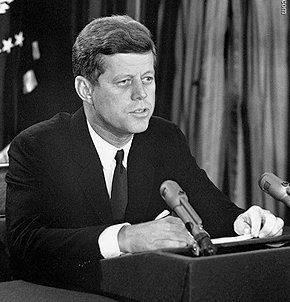
At 7 p.m. on Monday, October 22, 1962, President Kennedy appeared on television to inform Americans of the recently discovered Soviet1 military buildup in Cuba including the ongoing2 installation of offensive nuclear missiles.
The President had learned of the buildup on October 16, when he was shown aerial photos taken by an American U-2 spy plane over Cuba, located just ninety miles off the coast of Florida.
On October 18, President Kennedy had conferred with Soviet Minister of Foreign Affairs, Andrei Gromyko, who stated the weapons were for defensive3 purposes only. The President then met with top military aides and his brother Robert to discuss possible military options. Secret recording4 of their meeting (10/18/62) - 2:12
Sunday, October 21, the President spent the entire day conferring with his advisers5. Two main military options were under consideration - a surgical6 air strike against the bases or a naval7 blockade of Cuba. The President chose the blockade, which would be labeled a "quarantine."
In his address, the President explained the threat, announced his decision, and stated the U.S. would consider any missile launched from Cuba against as an attack by the U.S.S.R.
Good evening my fellow citizens:
This Government, as promised, has maintained the closest surveillance of the Soviet Military buildup on the island of Cuba. Within the past week, unmistakable evidence has established the fact that a series of offensive missile sites is now in preparation on that imprisoned8 island. The purpose of these bases can be none other than to provide a nuclear strike capability9 against the Western Hemisphere.
Upon receiving the first preliminary hard information of this nature last Tuesday morning at 9 a.m., I directed that our surveillance be stepped up. And having now confirmed and completed our evaluation10 of the evidence and our decision on a course of action, this Government feels obliged to report this new crisis to you in fullest detail.
The characteristics of these new missile sites indicate two distinct types of installations. Several of them include medium range ballistic missiles capable of carrying a nuclear warhead for a distance of more than 1,000 nautical11 miles. Each of these missiles, in short, is capable of striking Washington, D.C., the Panama Canal, Cape12 Canaveral, Mexico City, or any other city in the southeastern part of the United States, in Central America, or in the Caribbean area.
Additional sites not yet completed appear to be designed for intermediate range ballistic missiles--capable of traveling more than twice as far--and thus capable of striking most of the major cities in the Western Hemisphere, ranging as far north as Hudson Bay, Canada, and as far south as Lima, Peru. In addition, jet bombers13, capable of carrying nuclear weapons, are now being uncrated and assembled in Cuba, while the necessary air bases are being prepared.
This urgent transformation14 of Cuba into an important strategic base--by the presence of these large, long range, and clearly offensive weapons of sudden mass destruction--constitutes an explicit15 threat to the peace and security of all the Americas, in flagrant and deliberate defiance16 of the Rio Pact17 of 1947, the traditions of this Nation and hemisphere, the joint18 resolution of the 87th Congress, the Charter of the United Nations, and my own public warnings to the Soviets19 on September 4 and 13. This action also contradicts the repeated assurances of Soviet spokesmen, both publicly and privately20 delivered, that the arms buildup in Cuba would retain its original defensive character, and that the Soviet Union had no need or desire to station strategic missiles on the territory of any other nation.
The size of this undertaking21 makes clear that it has been planned for some months. Yet only last month, after I had made clear the distinction between any introduction of ground-to-ground missiles and the existence of defensive antiaircraft missiles, the Soviet Government publicly stated on September 11, and I quote, "the armaments and military equipment sent to Cuba are designed exclusively for defensive purposes," that, and I quote the Soviet Government, "there is no need for the Soviet Government to shift its weapons . . . for a retaliatory22 blow to any other country, for instance Cuba," and that, and I quote their government, "the Soviet Union has so powerful rockets to carry these nuclear warheads that there is no need to search for sites for them beyond the boundaries of the Soviet Union." That statement was false.
Only last Thursday, as evidence of this rapid offensive buildup was already in my hand, Soviet Foreign Minister Gromyko told me in my office that he was instructed to make it clear once again, as he said his government had already done, that Soviet assistance to Cuba, and I quote, "pursued solely23 the purpose of contributing to the the defense24 capabilities25 of Cuba," that, and I quote him, "training by Soviet specialists of Cuban nationals in handling defensive armaments was by no means offensive, and if it were otherwise," Mr. Gromyko went on, "the Soviet Government would never become involved in rendering26 such assistance." That statement also was false.
Neither the United States of America nor the world community of nations can tolerate deliberate deception27 and offensive threats on the part of any nation, large or small. We no longer live in a world where only the actual firing of weapons represents a sufficient challenge to a nation's security to constitute maximum peril28. Nuclear weapons are so destructive and ballistic missiles are so swift, that any substantially increased possibility of their use or any sudden change in their deployment29 may well be regarded as a definite threat to peace.
For many years both the Soviet Union and the United States, recognizing this fact, have deployed30 strategic nuclear weapons with great care, never upsetting the precarious31 status quo which insured that these weapons would not be used in the absence of some vital challenge. Our own strategic missiles have never been transferred to the territory of any other nation under a cloak of secrecy32 and deception; and our history--unlike that of the Soviets since the end of World War II--demonstrates that we have no desire to dominate or conquer any other nation or impose our system upon its people. Nevertheless, American citizens have become adjusted to living daily on the Bull's-eye of Soviet missiles located inside the U.S.S.R. or in submarines.
In that sense, missiles in Cuba add to an already clear and present danger--although it should be noted33 the nations of Latin America have never previously34 been subjected to a potential nuclear threat.#p#
But this secret, swift, and extraordinary buildup of Communist missiles--in an area well known to have a special and historical relationship to the United States and the nations of the Western Hemisphere, in violation35 of Soviet assurances, and in defiance of American and hemispheric policy--this sudden, clandestine36 decision to station strategic weapons for the first time outside of Soviet soil--is a deliberately37 provocative38 and unjustified change in the status quo which cannot be accepted by this country, if our courage and our commitments are ever to be trusted again by either friend or foe40.
The 1930's taught us a clear lesson: aggressive conduct, if allowed to go unchecked and unchallenged ultimately leads to war. This nation is opposed to war. We are also true to our word. Our unswerving objective, therefore, must be to prevent the use of these missiles against this or any other country, and to secure their withdrawal41 or elimination42 from the Western Hemisphere.
Our policy has been one of patience and restraint, as befits a peaceful and powerful nation, which leads a worldwide alliance. We have been determined43 not to be diverted from our central concerns by mere44 irritants and fanatics45. But now further action is required--and it is under way; and these actions may only be the beginning. We will not prematurely46 or unnecessarily risk the costs of worldwide nuclear war in which even the fruits of victory would be ashes in our mouth--but neither will we shrink from that risk at any time it must be faced.
Acting47, therefore, in the defense of our own security and of the entire Western Hemisphere, and under the authority entrusted48 to me by the Constitution as endorsed49 by the resolution of the Congress, I have directed that the following initial steps be taken immediately:
First: To halt this offensive buildup, a strict quarantine on all offensive military equipment under shipment to Cuba is being initiated51. All ships of any kind bound for Cuba from whatever nation or port will, if found to contain cargoes53 of offensive weapons, be turned back. This quarantine will be extended, if needed, to other types of cargo52 and carriers. We are not at this time, however, denying the necessities of life as the Soviets attempted to do in their Berlin blockade of 1948.
Second: I have directed the continued and increased close surveillance of Cuba and its military buildup. The foreign ministers of the OAS, in their communique of October 6, rejected secrecy in such matters in this hemisphere. Should these offensive military preparations continue, thus increasing the threat to the hemisphere, further action will be justified39. I have directed the Armed Forces to prepare for any eventualities; and I trust that in the interest of both the Cuban people and the Soviet technicians at the sites, the hazards to all concerned in continuing this threat will be recognized.
Third: It shall be the policy of this Nation to regard any nuclear missile launched from Cuba against any nation in the Western Hemisphere as an attack by the Soviet Union on the United States, requiring a full retaliatory response upon the Soviet Union.
Fourth: As a necessary military precaution, I have reinforced our base at Guantanamo, evacuated54 today the dependents of our personnel there, and ordered additional military units to be on a standby alert basis.
Fifth: We are calling tonight for an immediate50 meeting of the Organ of Consultation55 under the Organization of American States, to consider this threat to hemispheric security and to invoke56 articles 6 and 8 of the Rio Treaty in support of all necessary action. The United Nations Charter allows for regional security arrangements--and the nations of this hemisphere decided57 long ago against the military presence of outside powers. Our other allies around the world have also been alerted.
Sixth: Under the Charter of the United Nations, we are asking tonight that an emergency meeting of the Security Council be convoked58 without delay to take action against this latest Soviet threat to world peace. Our resolution will call for the prompt dismantling59 and withdrawal of all offensive weapons in Cuba, under the supervision60 of U.N. observers, before the quarantine can be lifted.
Seventh and finally: I call upon Chairman Khrushchev to halt and eliminate this clandestine, reckless and provocative threat to world peace and to stable relations between our two nations. I call upon him further to abandon this course of world domination, and to join in an historic effort to end the perilous61 arms race and to transform the history of man. He has an opportunity now to move the world back from the abyss of destruction--by returning to his government's own words that it had no need to station missiles outside its own territory, and withdrawing these weapons from Cuba--by refraining from any action which will widen or deepen the present crisis--and then by participating in a search for peaceful and permanent solutions.
This Nation is prepared to present its case against the Soviet threat to peace, and our own proposals for a peaceful world, at any time and in any forum--in the OAS, in the United Nations, or in any other meeting that could be useful--without limiting our freedom of action. We have in the past made strenuous62 efforts to limit the spread of nuclear weapons. We have proposed the elimination of all arms and military bases in a fair and effective disarmament treaty. We are prepared to discuss new proposals for the removal of tensions on both sides--including the possibility of a genuinely independent Cuba, free to determine its own destiny. We have no wish to war with the Soviet Union--for we are a peaceful people who desire to live in peace with all other peoples.
But it is difficult to settle or even discuss these problems in an atmosphere of intimidation63. That is why this latest Soviet threat--or any other threat which is made independently or in response to our actions this week--must and will be met with determination. Any hostile move anywhere in the world against the safety and freedom of peoples to whom we are committed--including in particular the brave people of West Berlin--will be met by whatever action is needed.
Finally, I want to say a few words to the captive people of Cuba, to whom this speech is being directly carried by special radio facilities. I speak to you as a friend, as one who knows of your deep attachment64 to your fatherland, as one who shares your aspirations65 for liberty and justice for all. And I have watched and the American people have watched with deep sorrow how your nationalist revolution was betrayed-- and how your fatherland fell under foreign domination. Now your leaders are no longer Cuban leaders inspired by Cuban ideals. They are puppets and agents of an international conspiracy66 which has turned Cuba against your friends and neighbors in the Americas--and turned it into the first Latin American country to become a target for nuclear war--the first Latin American country to have these weapons on its soil.
These new weapons are not in your interest. They contribute nothing to your peace and well-being67. They can only undermine it. But this country has no wish to cause you to suffer or to impose any system upon you. We know that your lives and land are being used as pawns68 by those who deny your freedom.
Many times in the past, the Cuban people have risen to throw out tyrants69 who destroyed their liberty. And I have no doubt that most Cubans today look forward to the time when they will be truly free--free from foreign domination, free to choose their own leaders, free to select their own system, free to own their own land, free to speak and write and worship without fear or degradation70. And then shall Cuba be welcomed back to the society of free nations and to the associations of this hemisphere.
My fellow citizens: let no one doubt that this is a difficult and dangerous effort on which we have set out. No one can see precisely71 what course it will take or what costs or casualties will be incurred72. Many months of sacrifice and self-discipline lie ahead--months in which our patience and our will will be tested--months in which many threats and denunciations will keep us aware of our dangers. But the greatest danger of all would be to do nothing.
The path we have chosen for the present is full of hazards, as all paths are--but it is the one most consistent with our character and courage as a nation and our commitments around the world. The cost of freedom is always high--and Americans have always paid it. And one path we shall never choose, and that is the path of surrender or submission73.
Our goal is not the victory of might, but the vindication74 of right- -not peace at the expense of freedom, but both peace and freedom, here in this hemisphere, and, we hope, around the world. God willing, that goal will be achieved.
Thank you and good night.
President John F. Kennedy - October 22, 1962
 收听单词发音
 |
1
Soviet
|
|
| adj.苏联的,苏维埃的;n.苏维埃 | |
参考例句: |
|
|
|
|
2
ongoing
|
|
| adj.进行中的,前进的 | |
参考例句: |
|
|
|
|
3
defensive
|
|
| adj.防御的;防卫的;防守的 | |
参考例句: |
|
|
|
|
4
recording
|
|
| n.录音,记录 | |
参考例句: |
|
|
|
|
5
advisers
|
|
| 顾问,劝告者( adviser的名词复数 ); (指导大学新生学科问题等的)指导教授 | |
参考例句: |
|
|
|
|
6
surgical
|
|
| adj.外科的,外科医生的,手术上的 | |
参考例句: |
|
|
|
|
7
naval
|
|
| adj.海军的,军舰的,船的 | |
参考例句: |
|
|
|
|
8
imprisoned
|
|
| 下狱,监禁( imprison的过去式和过去分词 ) | |
参考例句: |
|
|
|
|
9
capability
|
|
| n.能力;才能;(pl)可发展的能力或特性等 | |
参考例句: |
|
|
|
|
10
evaluation
|
|
| n.估价,评价;赋值 | |
参考例句: |
|
|
|
|
11
nautical
|
|
| adj.海上的,航海的,船员的 | |
参考例句: |
|
|
|
|
12
cape
|
|
| n.海角,岬;披肩,短披风 | |
参考例句: |
|
|
|
|
13
bombers
|
|
| n.轰炸机( bomber的名词复数 );投弹手;安非他明胶囊;大麻叶香烟 | |
参考例句: |
|
|
|
|
14
transformation
|
|
| n.变化;改造;转变 | |
参考例句: |
|
|
|
|
15
explicit
|
|
| adj.详述的,明确的;坦率的;显然的 | |
参考例句: |
|
|
|
|
16
defiance
|
|
| n.挑战,挑衅,蔑视,违抗 | |
参考例句: |
|
|
|
|
17
pact
|
|
| n.合同,条约,公约,协定 | |
参考例句: |
|
|
|
|
18
joint
|
|
| adj.联合的,共同的;n.关节,接合处;v.连接,贴合 | |
参考例句: |
|
|
|
|
19
soviets
|
|
| 苏维埃(Soviet的复数形式) | |
参考例句: |
|
|
|
|
20
privately
|
|
| adv.以私人的身份,悄悄地,私下地 | |
参考例句: |
|
|
|
|
21
undertaking
|
|
| n.保证,许诺,事业 | |
参考例句: |
|
|
|
|
22
retaliatory
|
|
| adj.报复的 | |
参考例句: |
|
|
|
|
23
solely
|
|
| adv.仅仅,唯一地 | |
参考例句: |
|
|
|
|
24
defense
|
|
| n.防御,保卫;[pl.]防务工事;辩护,答辩 | |
参考例句: |
|
|
|
|
25
capabilities
|
|
| n.能力( capability的名词复数 );可能;容量;[复数]潜在能力 | |
参考例句: |
|
|
|
|
26
rendering
|
|
| n.表现,描写 | |
参考例句: |
|
|
|
|
27
deception
|
|
| n.欺骗,欺诈;骗局,诡计 | |
参考例句: |
|
|
|
|
28
peril
|
|
| n.(严重的)危险;危险的事物 | |
参考例句: |
|
|
|
|
29
deployment
|
|
| n. 部署,展开 | |
参考例句: |
|
|
|
|
30
deployed
|
|
| (尤指军事行动)使展开( deploy的过去式和过去分词 ); 施展; 部署; 有效地利用 | |
参考例句: |
|
|
|
|
31
precarious
|
|
| adj.不安定的,靠不住的;根据不足的 | |
参考例句: |
|
|
|
|
32
secrecy
|
|
| n.秘密,保密,隐蔽 | |
参考例句: |
|
|
|
|
33
noted
|
|
| adj.著名的,知名的 | |
参考例句: |
|
|
|
|
34
previously
|
|
| adv.以前,先前(地) | |
参考例句: |
|
|
|
|
35
violation
|
|
| n.违反(行为),违背(行为),侵犯 | |
参考例句: |
|
|
|
|
36
clandestine
|
|
| adj.秘密的,暗中从事的 | |
参考例句: |
|
|
|
|
37
deliberately
|
|
| adv.审慎地;蓄意地;故意地 | |
参考例句: |
|
|
|
|
38
provocative
|
|
| adj.挑衅的,煽动的,刺激的,挑逗的 | |
参考例句: |
|
|
|
|
39
justified
|
|
| a.正当的,有理的 | |
参考例句: |
|
|
|
|
40
foe
|
|
| n.敌人,仇敌 | |
参考例句: |
|
|
|
|
41
withdrawal
|
|
| n.取回,提款;撤退,撤军;收回,撤销 | |
参考例句: |
|
|
|
|
42
elimination
|
|
| n.排除,消除,消灭 | |
参考例句: |
|
|
|
|
43
determined
|
|
| adj.坚定的;有决心的 | |
参考例句: |
|
|
|
|
44
mere
|
|
| adj.纯粹的;仅仅,只不过 | |
参考例句: |
|
|
|
|
45
fanatics
|
|
| 狂热者,入迷者( fanatic的名词复数 ) | |
参考例句: |
|
|
|
|
46
prematurely
|
|
| adv.过早地,贸然地 | |
参考例句: |
|
|
|
|
47
acting
|
|
| n.演戏,行为,假装;adj.代理的,临时的,演出用的 | |
参考例句: |
|
|
|
|
48
entrusted
|
|
| v.委托,托付( entrust的过去式和过去分词 ) | |
参考例句: |
|
|
|
|
49
endorsed
|
|
| vt.& vi.endorse的过去式或过去分词形式v.赞同( endorse的过去式和过去分词 );在(尤指支票的)背面签字;在(文件的)背面写评论;在广告上说本人使用并赞同某产品 | |
参考例句: |
|
|
|
|
50
immediate
|
|
| adj.立即的;直接的,最接近的;紧靠的 | |
参考例句: |
|
|
|
|
51
initiated
|
|
| n. 创始人 adj. 新加入的 vt. 开始,创始,启蒙,介绍加入 | |
参考例句: |
|
|
|
|
52
cargo
|
|
| n.(一只船或一架飞机运载的)货物 | |
参考例句: |
|
|
|
|
53
cargoes
|
|
| n.(船或飞机装载的)货物( cargo的名词复数 );大量,重负 | |
参考例句: |
|
|
|
|
54
evacuated
|
|
| 撤退者的 | |
参考例句: |
|
|
|
|
55
consultation
|
|
| n.咨询;商量;商议;会议 | |
参考例句: |
|
|
|
|
56
invoke
|
|
| v.求助于(神、法律);恳求,乞求 | |
参考例句: |
|
|
|
|
57
decided
|
|
| adj.决定了的,坚决的;明显的,明确的 | |
参考例句: |
|
|
|
|
58
convoked
|
|
| v.召集,召开(会议)( convoke的过去式和过去分词 ) | |
参考例句: |
|
|
|
|
59
dismantling
|
|
| (枪支)分解 | |
参考例句: |
|
|
|
|
60
supervision
|
|
| n.监督,管理 | |
参考例句: |
|
|
|
|
61
perilous
|
|
| adj.危险的,冒险的 | |
参考例句: |
|
|
|
|
62
strenuous
|
|
| adj.奋发的,使劲的;紧张的;热烈的,狂热的 | |
参考例句: |
|
|
|
|
63
intimidation
|
|
| n.恐吓,威胁 | |
参考例句: |
|
|
|
|
64
attachment
|
|
| n.附属物,附件;依恋;依附 | |
参考例句: |
|
|
|
|
65
aspirations
|
|
| 强烈的愿望( aspiration的名词复数 ); 志向; 发送气音; 发 h 音 | |
参考例句: |
|
|
|
|
66
conspiracy
|
|
| n.阴谋,密谋,共谋 | |
参考例句: |
|
|
|
|
67
well-being
|
|
| n.安康,安乐,幸福 | |
参考例句: |
|
|
|
|
68
pawns
|
|
| n.(国际象棋中的)兵( pawn的名词复数 );卒;被人利用的人;小卒v.典当,抵押( pawn的第三人称单数 );以(某事物)担保 | |
参考例句: |
|
|
|
|
69
tyrants
|
|
| 专制统治者( tyrant的名词复数 ); 暴君似的人; (古希腊的)僭主; 严酷的事物 | |
参考例句: |
|
|
|
|
70
degradation
|
|
| n.降级;低落;退化;陵削;降解;衰变 | |
参考例句: |
|
|
|
|
71
precisely
|
|
| adv.恰好,正好,精确地,细致地 | |
参考例句: |
|
|
|
|
72
incurred
|
|
| [医]招致的,遭受的; incur的过去式 | |
参考例句: |
|
|
|
|
73
submission
|
|
| n.服从,投降;温顺,谦虚;提出 | |
参考例句: |
|
|
|
|
74
vindication
|
|
| n.洗冤,证实 | |
参考例句: |
|
|
|


